
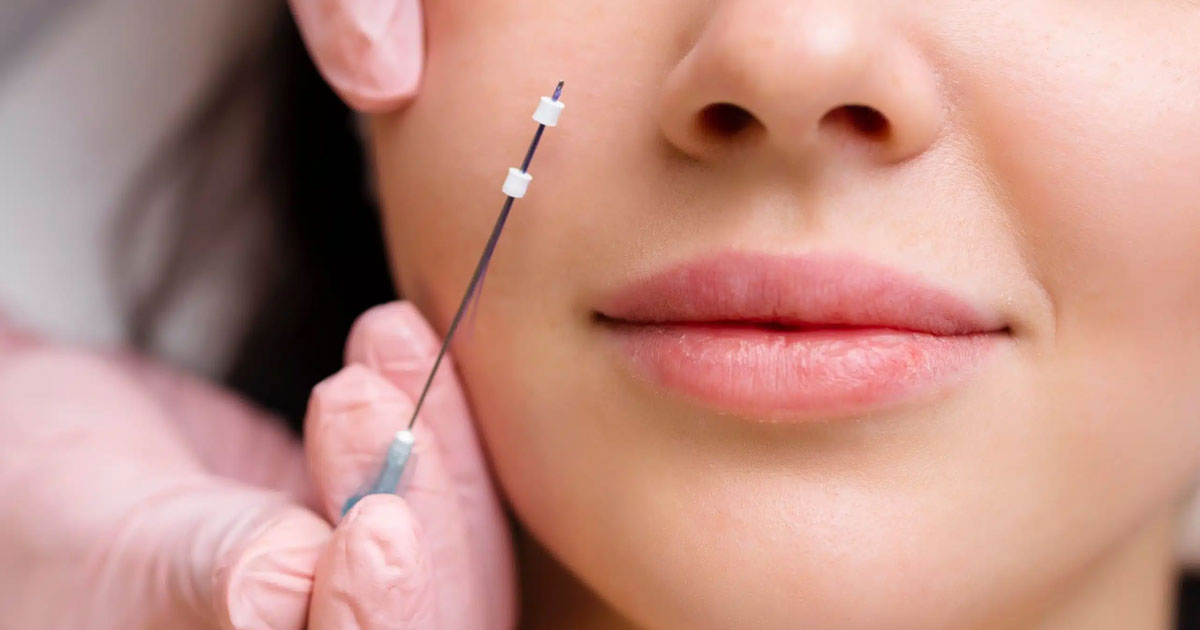
Specialized face lift
Thread implantation requires a high level of skill. The layers of the skin must be known. It is very important that the thread path is uniform, both for collagen-building threads placed in the dermis and for lift threads placed in the subcutaneous fat, so as not to damage the underlying layers of the skin, nerves, and blood vessels, and to have a uniform and uniform collagen-building lift.
- Eyebrow and eye corner lift
- Mimic line control
Dr. Karimi's tips about thread lift:
Non-absorbable threads are silicone threads, silk threads, nylon threads. An example is spring thread. In terms of type, threads are divided into single-needle and double-needle threads. Single-needle threads are either barbed (in fact, they may have tiny barbs), or barbed. Barbed threads are called cog threads. And barbed threads are divided into two groups: mono and screw. Mono is a simple thread, and screw threads are divided into single-strand and double-strand threads, which are also called tornado. Cog threads or barbed threads are of two groups: single-needle and double-needle. Double-needle threads include Eposte, Silhouette, and Spring.
Threads are divided into two types: absorbable and non-absorbable. Absorbable threads used in beauty include PDO, PLLA, and PCL. These are available in single or combined forms such as PLLACL. The majority of threads on the market are PDO. The most important two-needle PLLACL threads are Silhouette and Optus.

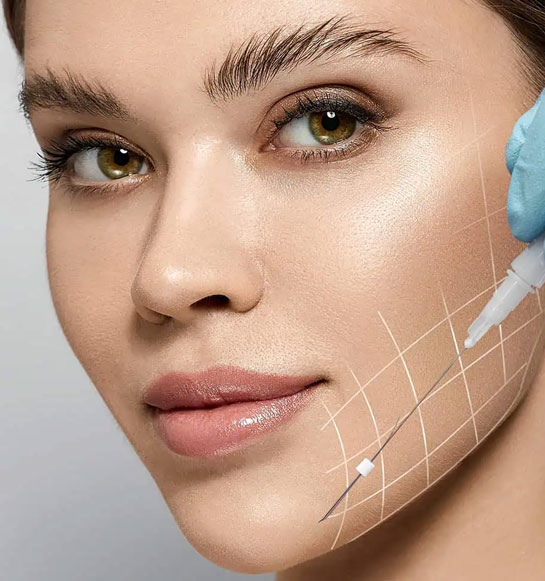
Facial tissue case with thread
Lift threads or cog threads, whether single-needle or double-needle, as well as silhouette and spring threads, which are double-needle, in addition to stimulating collagen production by moving the tissue, also cause a lift. So the condition for performing a lift is the possibility of moving the tissue. As a result, not everyone is a case lifter; a case lifter is someone whose tissue can be moved at least two centimeters with gentle stretching.
Thread rejuvenation mechanism
Whether it’s single-needle threads, double-needle threads, simple threads, or screw threads, they all force the body to stimulate collagen production through a foreign body reaction. As a result, we have an accumulation of collagen in the area where the thread is. Collagen is the most important protein in the skin, and with the production of collagen, the skin’s water retention capacity increases, pores become smaller, and the skin becomes clearer and brighter. In fact, the rejuvenation we seek using threads is through the stimulation of collagen production. The more threads and the longer the threads remain in place, the more collagen production will result.
Complications of thread planting
Under normal conditions of thread implantation and proper case selection, no significant complications are observed. We may have inflammation or swelling due to the workload or the type of anesthesia or foreign body sensation, which the body gradually adapts to and is normal. Also, in the case of cog threads, 10 to 20% of initial unevenness may be observed, which will usually gradually correct within one to two weeks with facial dynamics including eating, sleeping, and talking.